Headroom: Reduce LLM Token Usage with Smart Context Optimization
Headroom: Reduce LLM Token Usage with Smart Context Optimization
Large Language Models (LLMs) have changed how we build software. Today, developers are creating AI chatbots, coding assistants, Retrieval-Augmented Generation (RAG) systems, AI agents, and Model Context Protocol (MCP) servers that can search documents, call APIs, execute tools, and reason across multiple data sources.
But as these applications become more powerful, they also become more expensive.
Not because the models are getting bigger—but because the amount of context we send to them keeps growing.
Every request can include:
- Previous chat history
- Retrieved documents
- Database records
- API responses
- Tool outputs
- Logs
- Large JSON payloads
- Memory from previous interactions
Although only part of this information is useful for answering the user's question, many applications send everything to the model.
The result?
- 💰 Higher API costs
- 🐢 Slower responses
- 📦 Larger prompts
- 🧠 Wasted context window
- ⚠️ More irrelevant information for the model to process
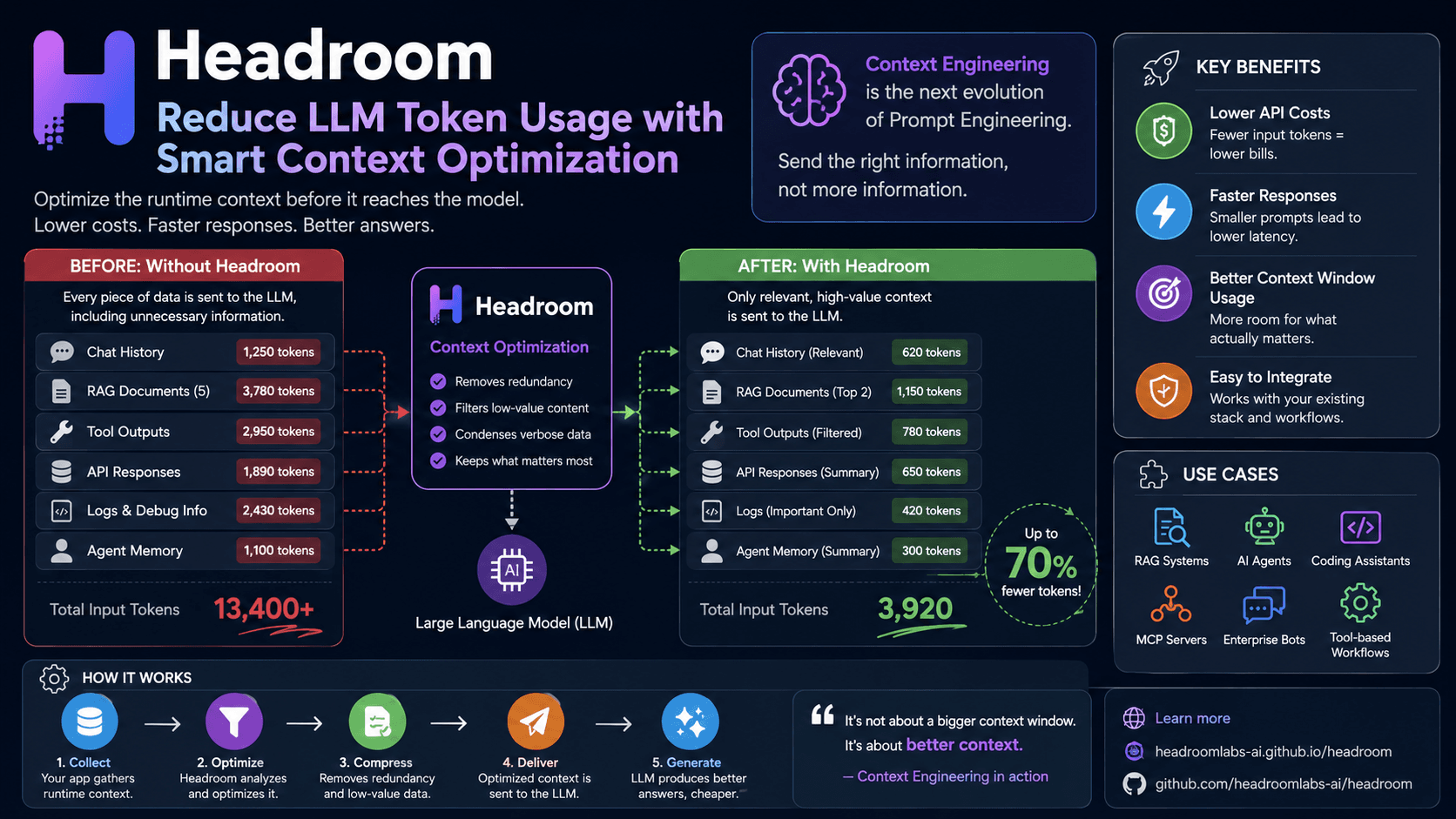
As AI applications continue to evolve, optimizing prompts alone is no longer enough. Developers are now focusing on Context Engineering—the practice of sending the right information to the model instead of simply sending more information.
One project gaining attention in this space is Headroom.
Instead of asking developers to manually trim prompts or remove unnecessary data, Headroom automatically optimizes runtime context before it reaches the LLM.
Let's see how it works.
Why Token Usage Is Becoming a Bigger Problem
When people think about LLM costs, they usually focus on the prompt itself.
In reality, the prompt is often the smallest part of the request.
Imagine you're building an AI customer support assistant.
A user asks:
Where is my latest order?
Before generating an answer, your application might collect information from several systems:
- Customer profile
- Previous conversations
- Order history
- Shipping API
- Support tickets
- Knowledge base articles
Without realizing it, your application may send thousands of tokens just to answer a simple question.
The same pattern appears in many modern AI systems:
RAG Applications
Vector databases often return multiple documents. Even if only a few paragraphs are relevant, entire documents may be included in the prompt.
AI Agents
An agent may call several tools before producing a final answer:
- Weather API
- Calendar
- Database
- Search engine
- File system
- Internal APIs
Every tool returns additional context.
Coding Assistants
Coding assistants frequently include:
- Stack traces
- Build logs
- Git diffs
- Source code
- Terminal output
These responses can become much larger than the user's original question.
Over time, unnecessary context becomes one of the biggest contributors to API costs.
What Is Headroom?
Headroom is an open-source context optimization layer designed for LLM applications.
Instead of replacing your language model, it works between your application and the model.
Its goal is simple:
Reduce unnecessary tokens while preserving the information the model actually needs.
Think of it as a smart filter for runtime context.
Rather than forwarding every API response, retrieved document, or tool output, Headroom analyzes the collected information and compresses it into a smaller, more useful version.
This approach helps applications become more efficient without changing the overall architecture.
Instead of modifying prompts throughout your codebase, you add an optimization layer before every LLM request.
How Headroom Works
A simplified request flow looks like this:
                User Request
                     │
                     ▼
             AI Application
                     │
                     ▼
 ┌────────────────────────────────────┐
 │ Collect Runtime Context            │
 │ • Chat History                     │
 │ • RAG Documents                    │
 │ • API Responses                    │
 │ • Tool Outputs                     │
 │ • Database Results                 │
 └────────────────────────────────────┘
                     │
                     ▼
          +-----------------------+
          |      Headroom         |
          | Context Optimization  |
          +-----------------------+
                     │
                     ▼
         Optimized Runtime Context
                     │
                     ▼
           Large Language Model
                     │
                     ▼
             Final AI Response
Instead of blindly truncating data, Headroom attempts to preserve the important information while reducing unnecessary context.
A typical workflow is:
- Your application gathers runtime context.
- Headroom analyzes the collected information.
- Repeated or low-value content is compressed.
- The optimized context is forwarded to the LLM.
- The model generates the final response.
The exact amount of token reduction depends on your workload, but applications that process verbose tool outputs, large JSON responses, or multiple retrieved documents often benefit the most.
In other words, Headroom doesn't try to make your model smarter—it helps your model spend more time processing useful information instead of unnecessary data.
Getting Started with Headroom
One of the biggest advantages of Headroom is that it doesn't require you to redesign your AI application.
Whether you're building with OpenAI, Anthropic, Gemini, LangChain, LiteLLM, or an MCP server, the idea remains the same:
Optimize the runtime context before sending it to the language model.
Instead of changing your prompts or switching LLM providers, you simply introduce a context optimization step into your existing request pipeline.
A simplified example looks like this:
// Without Headroom
const response = await llm.generate({
  messages,
  context,
});
With Headroom:
// Optimize runtime context first
const optimizedContext = await headroom.optimize(context);

const response = await llm.generate({
  messages,
  context: optimizedContext,
});
The API may differ depending on the framework you're using, but the overall workflow remains the same.
Before vs After
Let's compare a typical LLM request.
Without Headroom
User Question
        │
        ▼

Chat History
+ RAG Documents
+ Tool Outputs
+ API Responses
+ Database Results
+ Logs
        │
        ▼

Large Language Model
Every piece of collected data is sent directly to the model, even if much of it isn't needed.
With Headroom
User Question
        │
        ▼

Chat History
RAG Documents
Tool Outputs
API Responses

        │
        ▼

Headroom
(Context Optimization)

        │
        ▼

Compressed Context

        │
        ▼

Large Language Model
Instead of processing thousands of unnecessary tokens, the model receives a smaller and more focused context.
Real-World Example: RAG Application
Imagine you're building a documentation chatbot.
A user asks:
How do I reset my password?
Your vector database retrieves five documentation pages.
Without optimization, all five pages may be included in the prompt.
Retrieved Documents

Page 1 - 1,500 words
Page 2 - 900 words
Page 3 - 1,200 words
Page 4 - 800 words
Page 5 - 1,100 words
Although only a few paragraphs answer the user's question, the LLM still needs to process every token.
By optimizing the retrieved context first, Headroom helps reduce unnecessary information before the request reaches the model.
This makes better use of the model's context window while reducing input tokens.
Real-World Example: AI Agents
AI agents often perform multiple tool calls before generating a final response.
For example, a travel planning agent might:
- Search flights
- Check hotel availability
- Read weather forecasts
- Query a calendar
- Retrieve local attractions
Each tool can return hundreds of lines of structured data.
Without optimization:
Search Results
+
Weather Response
+
Hotel Listings
+
Calendar Events
+
Maps Data
↓
Large Prompt
With Headroom:
Relevant Flight
+
Best Hotel Options
+
Weather Summary
+
Important Calendar Events
↓
Smaller Prompt
Instead of forwarding every API response, only the information relevant to the user's request is emphasized.
AI Coding Assistants
Coding assistants are another excellent use case.
A debugging request may include:
- Source code
- Stack traces
- Compiler output
- Terminal logs
- Git diff
- Dependency information
Some build logs alone can contain thousands of tokens.
Rather than sending every log line to the LLM, Headroom can optimize this runtime context before the request is processed.
This is particularly useful for:
- IDE assistants
- CI/CD debugging tools
- Code review assistants
- AI pair programmers
Why Headroom Matters
Context optimization isn't just about reducing API costs.
It also improves how efficiently your AI application uses the model's context window.
Some of the biggest advantages include:
Lower Token Costs
Most LLM providers charge based on the number of input and output tokens.
If your application processes thousands of requests every day, reducing unnecessary input tokens can significantly lower operating costs over time.
Faster Responses
Smaller prompts generally require less processing.
Although improvements vary depending on the model and workload, reducing unnecessary context often leads to lower end-to-end latency.
Better Context Window Usage
Every model has a maximum context limit.
Sending repeated or irrelevant information leaves less room for the content that actually matters.
By compressing runtime context, Headroom helps applications make better use of the available context window.
Easy to Integrate
One reason developers are interested in Headroom is that it fits into existing AI pipelines.
Whether your application uses:
- LangChain
- LiteLLM
- MCP
- Custom Node.js services
- Python AI applications
- Multi-agent workflows
Headroom acts as an optimization layer instead of requiring a complete redesign.
That's an important distinction because it means you can improve efficiency without changing your business logic or switching LLM providers.
Headroom vs. Prompt Engineering
One common misconception is that Headroom replaces prompt engineering.
It doesn't.
Both solve different problems and work best together.
| Prompt Engineering | Headroom |
|---|---|
| Improves the instructions given to the model | Optimizes the runtime context sent to the model |
| Focuses on how you ask the question | Focuses on what supporting information is included |
| Usually written manually | Runs automatically before each request |
| Static unless updated by the developer | Dynamic and adapts to every request |
Think of it this way:
- Prompt Engineering improves the quality of your instructions.
- Headroom improves the quality of your context.
A well-written prompt is still important, but even the best prompt can't fix a request overloaded with irrelevant data.
Headroom vs. LLMLingua
If you've explored token optimization before, you may have come across LLMLingua. While both tools aim to reduce token usage, they approach the problem differently.
| Headroom | LLMLingua |
|---|---|
| Optimizes runtime context before sending it to the LLM | Compresses prompts using token compression techniques |
| Fits naturally into AI agents, RAG pipelines, and tool-based workflows | Primarily focuses on prompt compression |
| Designed as a context optimization layer | Designed as a prompt compression solution |
| Works well with dynamic application data | Often used when prompt length itself is the main issue |
In many modern AI applications, the biggest source of token usage isn't the prompt—it's the runtime context collected from APIs, tools, memory, and retrieval systems.
That's why context optimization is becoming increasingly important as AI applications grow in complexity.
Context Engineering: The Next Step After Prompt Engineering
Over the past few years, Prompt Engineering has become a common skill for developers working with LLMs.
Today, another concept is gaining attention:
Context Engineering.
Instead of only asking:
How should I write my prompt?
developers are now asking:
What information should the model receive in the first place?
This shift is important because modern AI systems rarely rely on prompts alone.
A single request might combine:
- Chat history
- RAG documents
- Memory
- Tool outputs
- API responses
- Database queries
- File contents
Choosing the right context is often just as important as choosing the right prompt.
Headroom fits naturally into this workflow by helping applications send a smaller, more relevant context to the model.
Best Practices
If you're planning to use Headroom in production, keep these recommendations in mind.
Measure Before You Optimize
Track metrics such as:
- Input tokens
- Output tokens
- API cost
- Response latency
Comparing these numbers before and after integration will help you understand whether Headroom is providing meaningful improvements.
Test with Real Production Data
Small demo examples rarely reflect real workloads.
Evaluate Headroom using:
- Long conversations
- Large JSON responses
- Tool outputs
- Build logs
- Retrieved documents
- Multi-agent workflows
This provides a much more accurate picture of its effectiveness.
Don't Replace Good Prompt Design
Headroom is not a replacement for clear prompts.
Continue writing:
- Clear system prompts
- Focused user prompts
- Structured tool descriptions
Prompt engineering and context optimization complement each other rather than compete.
Monitor Response Quality
Reducing tokens should never reduce answer quality.
Always compare model responses before and after optimization to ensure that important information is still preserved.
Common Mistakes
When developers first start optimizing context, a few misconceptions are common.
Expecting Fixed Token Savings
There isn't a universal percentage of token reduction.
The amount of optimization depends on the type of data your application processes. Verbose logs, API responses, and large retrieved documents usually benefit more than already concise inputs.
Optimizing Too Early
If your application sends only short prompts with minimal context, adding another optimization layer may provide little value.
Start by measuring where your tokens are actually being spent.
Ignoring Observability
Optimization should be measurable.
Monitor token usage, latency, API costs, and answer quality over time so you can verify that the optimization is delivering real benefits.
Frequently Asked Questions
Does Headroom replace Prompt Engineering?
No. Prompt engineering improves how you communicate with the model, while Headroom optimizes the runtime context sent alongside those instructions.
Does Headroom work only for RAG?
No.
Although RAG is a popular use case, Headroom is also useful for:
- AI agents
- Coding assistants
- MCP servers
- Enterprise chatbots
- Tool-based workflows
- Long conversations
Any application that sends large amounts of dynamic context can potentially benefit.
Will Headroom reduce my OpenAI API costs?
It can, but the amount depends on your workload.
Applications with large tool outputs, extensive retrieval results, or verbose structured data generally have more opportunities for token reduction than applications with already concise prompts.
Should every AI application use Headroom?
Not necessarily.
If your prompts are short and your application includes very little runtime context, the additional optimization layer may not provide significant benefits.
However, for context-heavy AI systems, it's worth evaluating with your own production data.
Final Thoughts
As AI applications continue to evolve, the challenge is no longer just choosing the best language model—it's managing the information that reaches it.
Large prompts filled with chat history, retrieved documents, tool outputs, and API responses can quickly increase costs and consume valuable context space. Simply increasing the context window isn't always the most efficient solution.
Headroom addresses this challenge by optimizing runtime context before it reaches the LLM. Instead of changing your application's architecture or rewriting prompts, it introduces a lightweight optimization layer that helps reduce unnecessary tokens while preserving the information most relevant to the user's request.
Whether you're building AI agents, RAG systems, coding assistants, or enterprise AI applications, context optimization is becoming an essential part of the development process.
As the AI ecosystem continues to mature, understanding Context Engineering will be just as valuable as understanding Prompt Engineering. Tools like Headroom show how thoughtful context management can improve efficiency, reduce costs, and help language models focus on what truly matters.
Learn More
- Official Documentation: https://headroomlabs-ai.github.io/headroom/
- GitHub Repository: https://github.com/headroomlabs-ai/headroom/