Loop Engineering in LLMs: Beyond Prompt Engineering
Large Language Models (LLMs) are incredibly good at generating text, writing code, answering questions, and summarizing information. However, not every problem can be solved with a single prompt.
Ask an LLM to explain JavaScript closures, and one response is usually enough.
Ask it to debug a large codebase, analyze logs, fix failing tests, and verify the solution, and a single response quickly becomes insufficient.
This is where Loop Engineering comes in.
Rather than treating an LLM as a one-shot text generator, Loop Engineering allows it to iteratively reason, gather more context, evaluate intermediate results, and refine its output until the objective is achieved.
In this article, we'll explore what Loop Engineering is, how it works, and why it has become an important pattern for modern LLM-powered applications.
What is Loop Engineering?
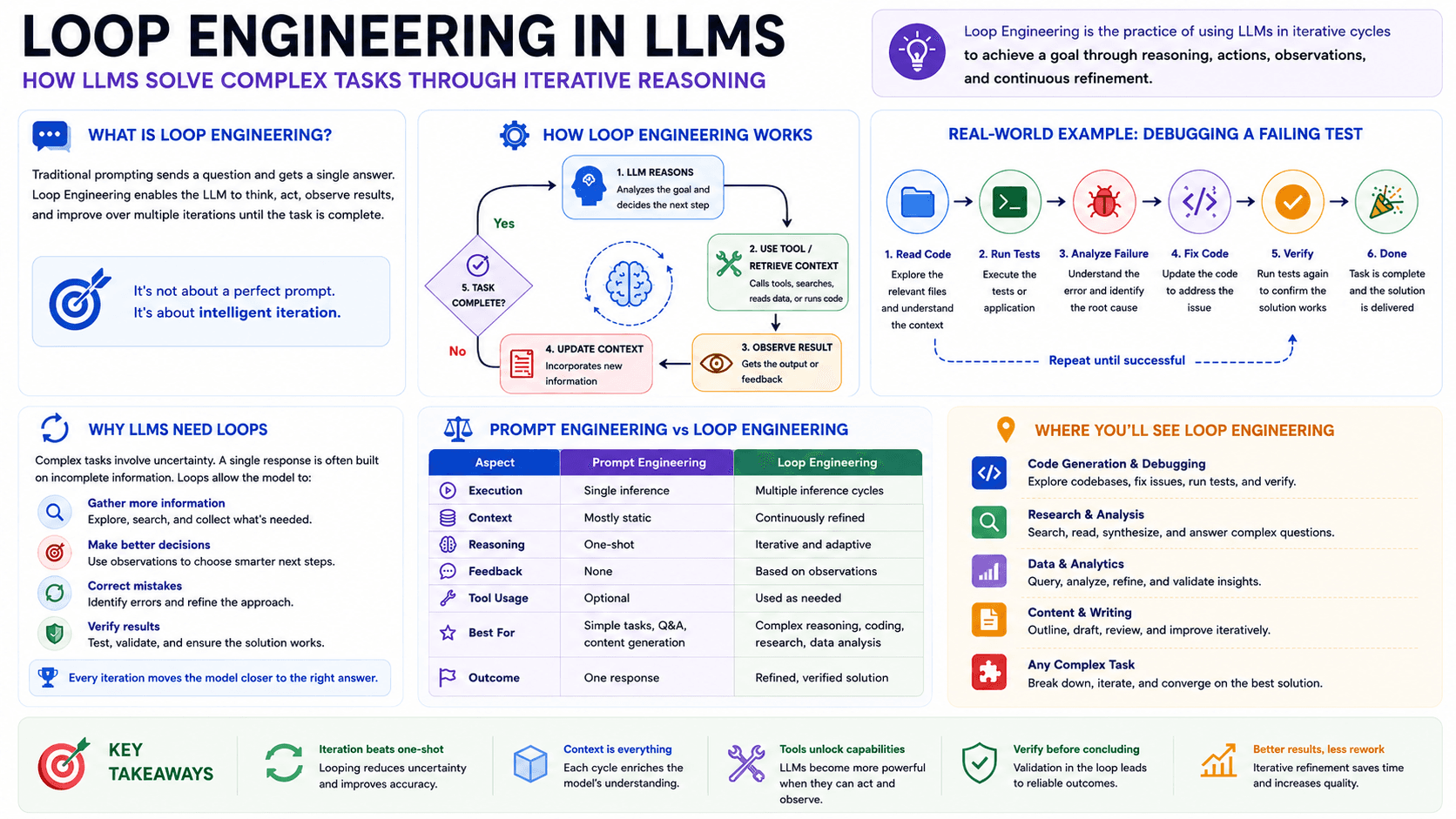
Loop Engineering is the practice of designing interactions where an LLM solves a problem through multiple reasoning cycles instead of a single inference.
Each iteration gives the model new information that improves the next decision.
Instead of expecting the first answer to be perfect, the LLM repeatedly:
- Understands the current context
- Decides the next action
- Retrieves additional information or uses a tool
- Evaluates the result
- Refines its reasoning
- Repeats until the task is complete
The goal isn't to generate longer responses—it's to generate better decisions.
How Loop Engineering Works
Unlike traditional prompting, the model doesn't stop after its first response. Instead, every observation becomes new context for the next reasoning step.
This iterative process reduces uncertainty and gradually improves the quality of the final output.
Why LLMs Need Loops
Imagine asking an LLM to fix a failing test suite.
Without Loop Engineering, the model only has the prompt and must make educated guesses.
With Loop Engineering, it can work step by step:
- Read the project structure.
- Inspect the relevant source files.
- Analyze the failing tests.
- Identify the root cause.
- Generate a fix.
- Verify the solution.
- Repeat if necessary.
Each iteration replaces assumptions with evidence.
This is why modern LLM-powered coding experiences often feel much more reliable than traditional one-shot prompting.
Prompt Engineering vs Loop Engineering
| Feature | Prompt Engineering | Loop Engineering |
|---|---|---|
| Execution | Single inference | Multiple inference cycles |
| Context | Mostly static | Continuously refined |
| Reasoning | One-shot | Iterative |
| Feedback | None | Based on observations |
| Tool Usage | Optional | Used when additional context is needed |
| Best For | Content generation, Q&A | Coding, debugging, research, planning |
| Outcome | One response | Refined solution |
Prompt Engineering focuses on how you ask the question.
Loop Engineering focuses on how the LLM works toward the answer.
Where You'll Encounter Loop Engineering
Even if you don't notice it directly, iterative reasoning is increasingly common in modern LLM applications.
You'll often encounter it in:
- AI coding assistants
- Retrieval-Augmented Generation (RAG)
- Research assistants
- Multi-step document analysis
- Software debugging
- Complex planning workflows
In each case, the LLM improves its output by continuously incorporating new context before producing a final response.
Final Thoughts
Loop Engineering doesn't replace Prompt Engineering—it builds upon it.
A good prompt still provides the right starting point, but complex problems often require more than one reasoning step.
By allowing an LLM to iteratively reason, gather context, evaluate results, and refine its understanding, Loop Engineering enables more reliable and accurate outcomes.
As LLMs continue to evolve with larger context windows, stronger reasoning capabilities, and better tool integration, Loop Engineering is becoming an essential pattern for solving real-world problems—not by asking better questions alone, but by allowing the model to think through them iteratively.
References
-
Anthropic — Building Effective AI Agents
https://www.anthropic.com/engineering/building-effective-agents -
ReAct: Synergizing Reasoning and Acting in Language Models
https://arxiv.org/abs/2210.03629