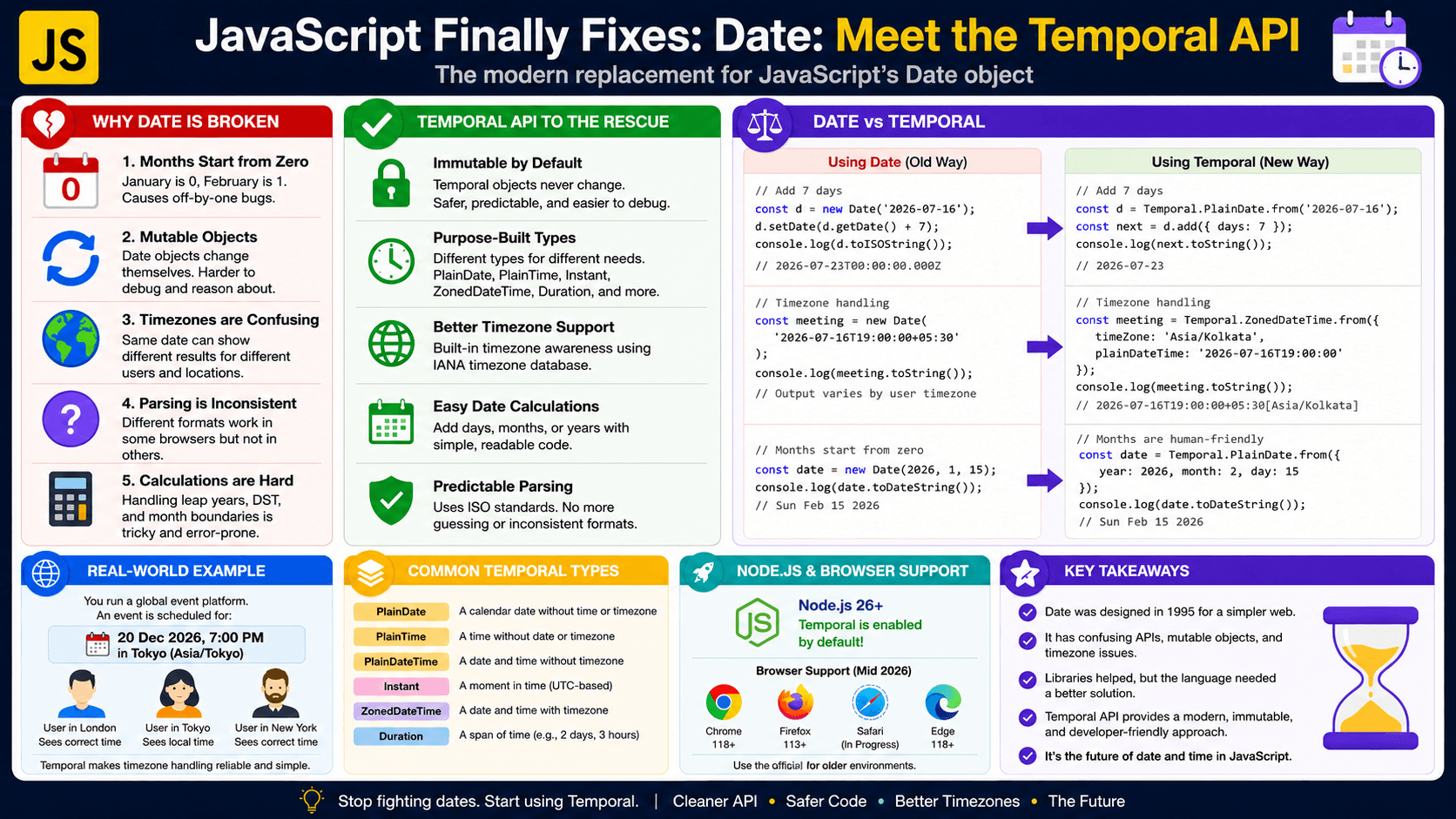
JavaScript Finally Fixes Date: Why the Temporal API is the Future
For over 25 years, JavaScript developers have relied on the built-in Date object to work with dates and times.
While it has powered everything from calendars to booking systems, developers have also spent years fighting unexpected bugs caused by confusing APIs, timezones, and inconsistent date parsing.
If you've ever searched for "JavaScript Date is broken", you're not alone.
The good news is that JavaScript finally has a modern replacement called Temporal API.
With Node.js 26 enabling Temporal by default and browser support continuing to improve, now is the perfect time to learn why it matters.
In this article, we'll understand:
- Why JavaScript's
Dateobject is considered broken - Common problems developers face
- How the Temporal API solves them
- Real-world examples
- Whether you should start using it today
Why is JavaScript Date Considered Broken?
The Date object was introduced in 1995, when JavaScript itself was created.
Back then, websites were simple. Developers rarely had to worry about multiple timezones, daylight saving time, recurring events, or global users.
Today's applications are completely different.
Modern apps need accurate scheduling, worldwide time support, and predictable date calculations.
Unfortunately, the old Date API wasn't designed for these requirements.
Let's look at some of its biggest problems.
Problem 1: Months Start from Zero
One of the most confusing parts of JavaScript's Date object is that months start at 0, not 1.
Imagine you're creating a birthday reminder for 15 February 2026.
You might naturally write:
new Date(2026, 2, 15);You probably expect this to represent 15 February.
Instead, JavaScript returns 15 March.
The correct code is:
new Date(2026, 1, 15);Month values are:
- 0 = January
- 1 = February
- 2 = March
This tiny detail has caused countless bugs in production applications.
Problem 2: Date Objects are Mutable
Another issue is that Date objects change themselves.
Consider this example.
const today = new Date();

today.setDate(today.getDate() + 7);

console.log(today);
The original object is modified.
Imagine two different functions using the same date object.
One function changes it, and suddenly another function starts producing incorrect results.
These hidden changes make debugging much harder.
Modern JavaScript prefers immutable objects because they are easier to reason about.
Problem 3: Timezones Can Be Confusing
Suppose you're building an online meeting application.
A meeting is scheduled for 7:00 PM in India.
A user in New York opens the same event.
const meeting =
new Date("2026-07-16T19:00:00+05:30");

console.log(meeting.toString());
The displayed time depends on the user's local timezone.
Without careful handling, users may see different dates or incorrect meeting times.
Timezone-related bugs are one of the most common problems developers face.
Problem 4: Parsing Dates Isn't Always Predictable
JavaScript accepts many date formats.
new Date("2026-07-16");

new Date("07/16/2026");

new Date("16 July 2026");
Some formats work everywhere.
Others behave differently depending on the browser or operating system.
Imagine users on different browsers seeing different results for the same input.
That's not something you want in production.
Problem 5: Date Calculations Are Harder Than They Should Be
Let's say you want to schedule a follow-up appointment 30 days later.
With Date, developers often write:
const date = new Date();

date.setDate(date.getDate() + 30);
At first, this looks simple.
But once leap years, daylight saving time, and timezone changes are involved, things become much more complicated.
Developers often end up using third-party libraries just to perform simple calculations safely.
How Developers Solved These Problems
Before Temporal, developers relied on libraries like:
- Moment.js
- Luxon
- date-fns
- Day.js
These libraries made working with dates much easier.
However, they were still workarounds for limitations in JavaScript itself.
The language needed a better built-in solution.
That's exactly why the Temporal API was created.
Meet the Temporal API
The Temporal API is a modern replacement for most uses of the old Date object.
Instead of one object trying to handle everything, Temporal introduces several specialized types.
Some of them include:
PlainDatePlainTimePlainDateTimeInstantZonedDateTimeDuration
Each type has a clear purpose, making code much easier to understand.
How Temporal Solves These Problems
Immutable Objects
Temporal objects never modify themselves.
const today =
Temporal.PlainDate.from("2026-07-16");

const tomorrow =
today.add({ days: 1 });

console.log(today.toString());
console.log(tomorrow.toString());
Output:
2026-07-16
2026-07-17
The original date remains unchanged.
This makes your code much safer.
Better Timezone Support
Temporal understands real-world timezones.
const now =
Temporal.Now.zonedDateTimeISO(
"Asia/Kolkata"
);

console.log(now.toString());
Instead of manually converting UTC offsets, you simply work with named timezones.
This is much easier for global applications.
Easier Date Calculations
Suppose your application schedules weekly meetings.
With Temporal:
const meeting =
Temporal.PlainDate.from("2026-07-16");

const nextMeeting =
meeting.add({ weeks: 1 });

console.log(nextMeeting.toString());
Output:
2026-07-23
No manual calculations.
No worrying about month boundaries.
Temporal handles everything correctly.
Predictable Parsing
Temporal only accepts well-defined formats.
Instead of guessing what a string means, it follows clear standards.
This reduces unexpected bugs caused by inconsistent parsing.
Date vs Temporal
| Feature | Date | Temporal |
|---|---|---|
| Mutable Objects | ❌ Yes | ✅ No |
| Timezone Support | Basic | Excellent |
| Date Calculations | Difficult | Easy |
| Parsing | Inconsistent | Predictable |
| Different Date Types | ❌ No | ✅ Yes |
| Modern API Design | ❌ No | ✅ Yes |
Temporal was designed using decades of lessons learned from the old Date object.
Real-World Example
Imagine you're building a hotel booking platform.
A customer books a room for:
20 December 2026
The hotel is located in Tokyo.
The customer lives in London.
The hotel manager is in New York.
With the old Date object, handling all these different timezones correctly often requires additional libraries and complex calculations.
With Temporal, timezone-aware objects make this much simpler and easier to understand.
Should You Start Using Temporal Today?
The old Date object isn't going away anytime soon.
Existing applications will continue working.
However, if you're starting a new project or learning modern JavaScript, it's worth learning Temporal now.
Node.js 26 already enables Temporal by default, and browser support continues to improve.
Until every environment fully supports it, developers can also use the official Temporal polyfill.
When Should You Use Temporal?
Temporal is an excellent choice if your application includes:
- Calendar apps
- Booking systems
- Flight scheduling
- Hotel reservations
- Financial software
- Global users
- Event management
- Appointment scheduling
If your application only needs to display today's date, the old Date object may still be sufficient.
For everything else, Temporal provides a much better developer experience.
Key Takeaways
- JavaScript's
Dateobject was created nearly 30 years ago. - It has confusing APIs, mutable objects, and timezone problems.
- Developers have relied on libraries like Moment.js and date-fns for years.
- The new Temporal API provides a cleaner and more predictable solution.
- Temporal supports immutable objects, better timezone handling, and easier date calculations.
- With Node.js 26 enabling Temporal by default, it's becoming the future of date and time handling in JavaScript.
Final Thoughts
The JavaScript Date object has served developers for decades, but modern applications demand something better.
The Temporal API doesn't just fix a few bugs—it completely redesigns how JavaScript handles dates and times.
Cleaner APIs, immutable objects, reliable timezone support, and easier calculations make it one of the biggest improvements to the language in recent years.
If you're a JavaScript developer, learning Temporal today will prepare you for the future of the ecosystem.
The next time you need to work with dates, you might not reach for Date() anymore—you'll reach for Temporal.