HTTP Finally Has a Dedicated QUERY Method: GET vs POST vs QUERY
For decades, developers have relied on GET and POST for almost every HTTP request. While these methods work well for most use cases, they have never been ideal for complex search and filtering operations.
The new HTTP QUERY method, standardized in RFC 10008, solves this long-standing problem by introducing a dedicated method for safe, idempotent, read-only requests that can include a request body.
In this article, we'll explore why QUERY was introduced, how it compares with GET and POST, and when you should use each.
Why Was a New HTTP Method Needed?
Modern applications rarely perform simple searches.
Think about an e-commerce website where users can filter products by:
- Category
- Multiple brands
- Price range
- Ratings
- Stock availability
- Delivery options
- Nested filters
- Sorting options
These filters can become quite complex.
Until now, developers had two options:
- Use GET with query parameters.
- Use POST with a JSON request body.
Neither solution was perfect.
GET: Great for Simple Retrieval
GET is the standard HTTP method for retrieving resources.
GET /products?category=laptop&brand=Apple&page=1&sort=priceAdvantages
- Safe
- Idempotent
- Cache-friendly
- Bookmarkable
- Supported by every HTTP client
GET is the best choice whenever the request is simple.
Limitations
As filters become more complex, URLs become difficult to maintain.
GET /products?brand=Apple&brand=Dell&priceMin=1000&priceMax=3000&rating=4&availability=in-stockNow imagine representing nested objects.
{
  "price": {
    "min": 1000,
    "max": 3000
  },
  "location": {
    "lat": 22.3,
    "lng": 70.7,
    "radius": 25
  }
}
Encoding this structure into query parameters quickly becomes messy.
Additionally, URLs have practical length limitations imposed by browsers, proxies, and servers.
POST: The Common Workaround
To overcome URL limitations, many APIs use POST.
POST /products/search
Content-Type: application/json

{
  "category": "Laptop",
  "brands": ["Apple", "Dell"],
  "price": {
    "min": 1000,
    "max": 3000
  },
  "sort": "-price"
}
Using a JSON request body makes complex filters much easier to represent.
However, there's one problem.
According to HTTP semantics, POST is intended for operations that process requests or modify server state.
Searching doesn't create, update, or delete anything.
Developers have simply been using POST because GET wasn't expressive enough.
Introducing HTTP QUERY
The new QUERY method combines the advantages of GET and POST.
QUERY /products
Content-Type: application/json

{
  "category": "Laptop",
  "brands": ["Apple", "Dell"],
  "price": {
    "min": 1000,
    "max": 3000
  },
  "rating": 4,
  "sort": "-price"
}
The request clearly communicates:
- Retrieve data
- Do not modify server state
- Accept complex structured request bodies
This is exactly what developers have wanted for years.
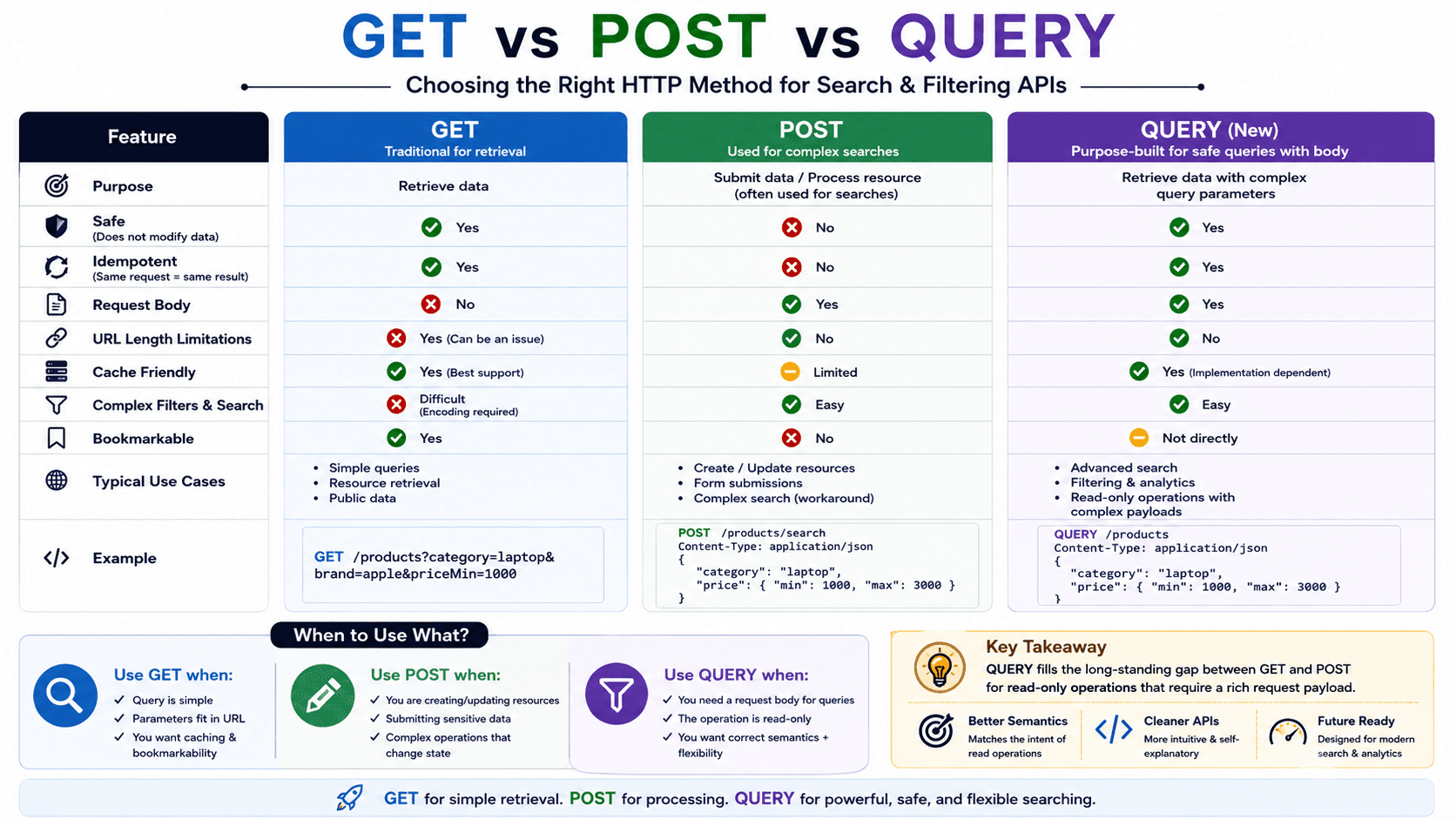
GET vs POST vs QUERY
| Feature | GET | POST | QUERY |
|---|---|---|---|
| Read Data | ✅ | ✅ | ✅ |
| Request Body | ❌ | ✅ | ✅ |
| Safe | ✅ | ❌ | ✅ |
| Idempotent | ✅ | ❌ | ✅ |
| Complex JSON Filters | ❌ | ✅ | ✅ |
| URL Length Issues | ✅ | ❌ | ❌ |
| Cache Friendly | ✅ | Limited | Possible* |
| Best Semantics for Search | ⚠️ | ❌ | ✅ |
Note: Caching support for
QUERYdepends on server, client, and intermediary implementations.
Real-World Example
Imagine building a property search API.
GET
GET /properties?city=London&type=Apartment&priceMin=100000&priceMax=500000Works well for simple searches.
POST
POST /properties/search

{
  "city": "London",
  "types": ["Apartment", "Villa"],
  "price": {
    "min": 100000,
    "max": 500000
  }
}
Allows complex filters but isn't semantically correct.
QUERY
QUERY /properties

{
  "city": "London",
  "types": ["Apartment", "Villa"],
  "price": {
    "min": 100000,
    "max": 500000
  }
}
Provides the same flexibility while accurately expressing that the operation is read-only.
Common Use Cases
The QUERY method is ideal for APIs involving:
- 🔍 Product search
- 🏠 Real estate filtering
- ✈️ Flight and hotel search
- 📊 Analytics dashboards
- 📈 Business intelligence
- 🤖 AI-powered semantic search
- 📚 Elasticsearch/OpenSearch
- 🌍 Geospatial queries
- 📋 Reporting APIs
Any endpoint that performs complex read-only queries can benefit.
Should You Use QUERY Today?
Not immediately.
Although RFC 10008 has standardized the method, ecosystem support is still evolving.
Frameworks, browsers, proxies, API gateways, and developer tools are gradually adding support.
For now, many production APIs will continue using POST /search for compatibility.
Over time, QUERY is expected to become the preferred choice for complex search operations.
When Should You Use Each Method?
Use GET when:
- Retrieving resources
- Query parameters are simple
- URLs should be shareable or bookmarkable
- Maximum caching is desired
Use POST when:
- Creating resources
- Uploading files
- Executing commands
- Performing operations that modify server state
Use QUERY when:
- Reading data
- Sending complex JSON filters
- Keeping proper HTTP semantics
- Designing modern search APIs
Final Thoughts
The introduction of QUERY doesn't replace GET or POST.
Instead, it fills a gap that has existed since the early days of HTTP.
- GET remains the best choice for simple retrieval.
- POST continues to power create and update operations.
- QUERY finally provides a standardized way to perform complex, read-only searches with structured request bodies.
It's a small addition to the HTTP specification, but one that makes modern API design cleaner, more expressive, and semantically correct.
As support grows across frameworks and infrastructure, don't be surprised if QUERY becomes the new standard for search and filtering endpoints.
References
- RFC 10008 — https://www.rfc-editor.org/info/rfc10008
- IETF Datatracker — https://datatracker.ietf.org/doc/rfc10008/